
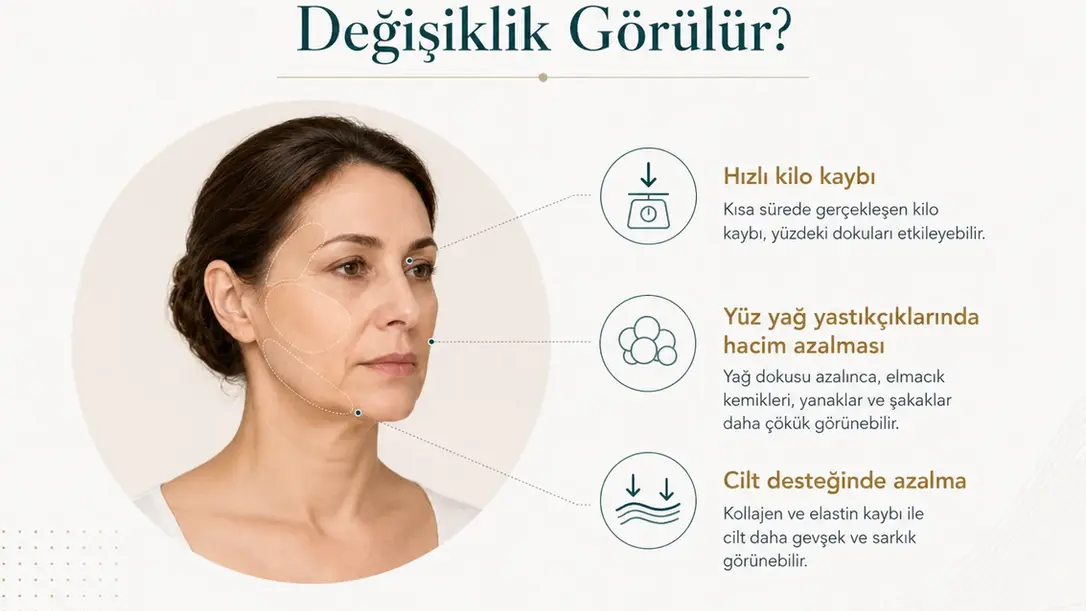
“Ozempic face” is not a medical diagnosis. In the media and aesthetic literature, the term is used to describe facial volume loss, hollowing, contour changes, and skin laxity that may appear in some people after substantial weight loss associated with GLP-1 receptor agonists. Importantly, this change in appearance should not be interpreted as a proven toxic effect of the medication specifically on facial tissues; current evidence suggests that rapid and marked weight loss plays a major role.
What do scientific studies show?
A 2025 retrospective imaging study examined 20 people who used a GLP-1 agonist and had CT or MRI scans before and after treatment. Mean weight loss was 11 kg. The researchers reported a median 9% reduction in total midfacial volume and a median 11% reduction in superficial volume. Weight loss was associated particularly with volume reduction in the superficial fat compartments. Because the sample was small, the findings cannot be generalized to every user, but they provide objective evidence that the phenomenon is not based solely on social-media observation.
An anatomical review published in 2026 emphasized that deflation of the superficial fat compartments, changes in deeper supporting tissues, and skin laxity may together influence appearance after rapid weight loss. Another study published that year proposed an anatomical model for prevention and treatment, but the model is conceptual and hypothesis-generating. It therefore cannot be claimed that every person using a GLP-1 medication will develop the same facial change, or that any particular aesthetic procedure will definitely prevent it.
Why does it not look the same in everyone?
Facial appearance does not depend only on total weight loss. Baseline facial-fat distribution, age, skin elasticity, the rate of weight loss, previous weight fluctuations, genetic characteristics, and accompanying lifestyle factors may all influence appearance. Two people who lose the same amount of weight may therefore experience very different facial changes.
How should aesthetic assessment be approached?
Assessment should not be reduced to simply “replacing lost volume.” It should first consider whether weight loss is continuing, which anatomical layers of the face have changed, skin quality, and the person’s general health. Hyaluronic-acid fillers, collagen-stimulating materials, and energy-based methods are discussed in the literature; however, strong long-term comparative studies showing that one approach is superior for GLP-1-associated facial changes remain limited.
The metabolic benefits of GLP-1 treatment should be considered separately from aesthetic concerns. The medication should not be stopped, its dose changed, or the weight-management plan altered solely because of appearance without assessment by the treating clinician.
Strength of the evidenceObjective imaging data support an association between weight loss and facial-volume reduction, but the study samples are small. Evidence for aesthetic treatment algorithms is weaker and is based largely on reviews, expert opinion, or limited clinical series. Individualized assessment and realistic expectation management are therefore important.
ReferencesYang et al. Radiographic Midfacial Volume Changes in Patients on GLP-1 Agonists. Otolaryngol Head Neck Surg. 2025. PMID: 40407186. DOI: 10.1002/ohn.1209.
Frank et al. GLP-1-Induced Weight Loss and the Face. Dermatol Surg. 2026. PMID: 42210888. DOI: 10.1097/DSS.0000000000005180.
Daneshgaran et al. “Ozempic Face” in Plastic Surgery: A Systematic Review. Aesthet Surg J Open Forum. 2025. PMID: 40626110.
This article is intended for general health information and is not personal diagnostic or treatment advice. The suitability, possible benefits, and risks of any medical or aesthetic procedure must be assessed through the individual’s medical history and clinical examination. Outcomes vary from person to person.
This article was prepared for general information by the Dr. Mehmet Yavaş clinic in Serdivan, Sakarya. Dr. Mehmet Yavaş · Arabacıalanı Mah. Mert Sk. No:46 Nurten Şükür İş Merkezi C-4 Kat:2, 54050 Serdivan / Sakarya


